

Choosing the right corrosion coating is one of the most critical engineering decisions in various industries. Epoxy and polyurethane coatings are two main options in the industrial market, each with its own characteristics, advantages, and limitations. But which one is truly more suitable for your operational environment?
This is not a simple question. The answer depends on several factors: the type of chemical you are dealing with, operating temperature, amount of sunlight exposure, ambient humidity, mechanical stresses, and of course, project budget. A wrong choice can lead to premature coating failure, increased maintenance costs, and even production shutdown.
In this technical article, with an engineering approach based on international standards, we compare epoxy and polyurethane anti-corrosion coatings from various aspects so that you can make the best decision for your industrial equipment.
Epoxy and Polyurethane Coatings; Nature and Chemical Structure
To understand the performance differences between these two coatings, we must first understand their chemical structure. This foundational knowledge is the key to understanding coating behavior in real-world conditions.
Molecular Structure of Epoxy
Epoxy resins are formed by the reaction of polyethylenes containing epoxide groups with curing agents (such as amines or polyamides). This reaction creates a dense, hard three-dimensional network with exceptional chemical resistance. The polar structure of epoxy creates strong bonds with metal surfaces, ensuring exceptional adhesion. For a deeper study of the mechanism of these coatings, you can refer to the comprehensive guide to epoxy coatings.
Molecular Structure of Polyurethane
Polyurethanes are formed by the reaction of isocyanates with polyols, and their molecular structure includes hard segments (urethane segments) and soft segments (polyol chains). This hybrid structure creates an unparalleled balance between hardness and flexibility. Recent research has shown that high-solid polyurethanes offer significant corrosion resistance.
Comprehensive Comparison of Technical Features of Epoxy and Polyurethane Corrosion Coatings
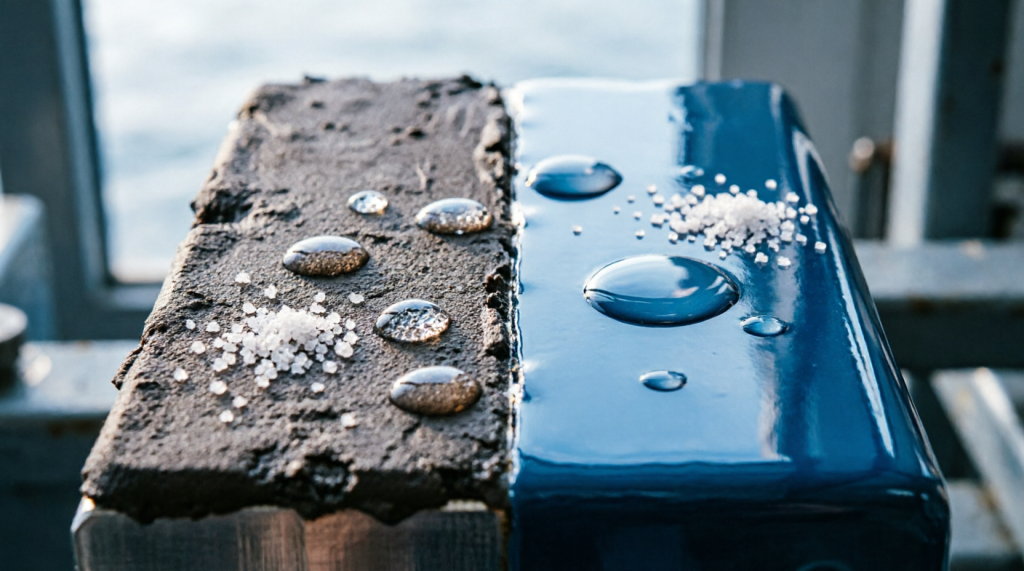
Now let’s compare these two coatings in terms of key features. This comparison will help you understand under which conditions each coating performs better.
Chemical and Corrosion Resistance
Epoxy coating has absolute superiority in this area. The dense epoxy network creates a powerful physical barrier against the penetration of water molecules, oxygen, and corrosive ions. This coating shows very high resistance to acids (such as sulfuric acid and hydrochloric acid), bases (such as caustic soda), and industrial solvents.
Polyurethane coating also has good chemical resistance, but it typically performs weaker than epoxy against strong acids and polar solvents. However, it performs acceptably against oils, greases, and many non-polar chemicals.
Thermal Resistance
Epoxy coating typically performs stably up to 120-150°C. At higher temperatures, yellowing, reduced adhesion, and cracking may occur. However, special formulations such as phenolic epoxy can withstand up to 200°C.
Polyurethane coating performs optimally at lower temperatures (typically up to 80-100°C) and may soften or lose its mechanical properties at higher temperatures.
Resistance to Ultraviolet (UV) Radiation
This is the main strength of polyurethane coating. Polyurethanes, especially aliphatic types, have excellent resistance to UV degradation. These coatings retain their color and gloss for many years.
Epoxy coating is vulnerable to UV radiation. Prolonged sunlight exposure causes surface chalking, loss of gloss, and eventually cracking and peeling. For this reason, epoxy is typically used as an intermediate or primer layer and should not be exposed to direct sunlight without a protective topcoat.
Adhesion and Permeability
Epoxy coating has excellent adhesion to various surfaces, especially metals. According to ASTM D4541, epoxy adhesion is typically over 20 MPa. Also, its permeability to water vapor and oxygen is very low, making it an excellent protective barrier.
Polyurethane coating also has good adhesion, but typically less than epoxy. Its permeability is also slightly higher than epoxy, although still at an acceptable level.
Flexibility and Mechanical Resistance
Polyurethane coating excels in this area. Its unique molecular structure imparts high flexibility to the coating, providing good resistance to impact, abrasion, and mechanical stresses. Polyurethanes can withstand several percent elongation without cracking.
Epoxy coating is harder and more brittle. Although it has high compressive strength, it is more limited in impact resistance and flexibility and may crack under mechanical stress.
Application Conditions and Curing Time
Epoxy coating typically has a longer curing time and is sensitive to ambient temperature. At low temperatures, curing becomes very slow and may take several days. Also, epoxy is sensitive to moisture, and applying it on wet surfaces requires special formulations.
Polyurethane coating typically cures faster and can be used at lower temperatures. However, it is very sensitive to moisture, and the presence of moisture during application can cause blistering and defects in the coating.
Comparative Table of Key Features
| Feature | Epoxy Coating | Polyurethane Coating |
|---|---|---|
| Chemical Resistance | Excellent (5/5) | Good (4/5) |
| Thermal Resistance | Good (120-150°C) | Moderate (80-100°C) |
| UV Resistance | Poor | Excellent |
| Adhesion | Excellent (>20 MPa) | Good (12-18 MPa) |
| Flexibility | Limited | High |
| Abrasion Resistance | Good | Excellent |
| Curing Time | Long | Moderate |
| Moisture Sensitivity | Moderate | High |
| Service Life | 15-20 years | 10-15 years |
| Initial Cost | Moderate | High |
Industrial Applications: Which Coating is More Suitable for Which Industry?
Choosing the right corrosion coating is highly dependent on the type of industry and operating conditions. In the following, we will examine the best applications for each coating.
Oil, Gas, and Petrochemical Industries
In these industries, equipment is exposed to corrosive chemicals, high temperatures, and sometimes humidity. Epoxy coating is the first choice for storage tanks, transfer pipelines, and reactors due to its high chemical resistance and strong adhesion. Phenolic epoxy is recommended for sections with temperatures above 150°C.
Marine Industries and Offshore Platforms
This environment is one of the harshest conditions for any coating. Here, hybrid systems perform best. Epoxy coating is used as a primer or intermediate layer to provide strong adhesion and corrosion protection, while polyurethane coating is applied as a topcoat for UV and mechanical abrasion protection. To learn more about the specific challenges of this environment, read the article Application of Anti-Corrosion Coatings in Marine Industries.
Chemical and Processing Industries
In environments dealing with strong acids, bases, and solvents, epoxy coating is the unrivaled choice. This coating shows resistance to a wide range of chemicals and is suitable for internal lining of tanks, pipes, and industrial floors.
Metal Structures and Bridges
For structures that are outdoors and exposed to sunlight, polyurethane coating is a better choice as a topcoat. This coating preserves the color and appearance of the structure for years and has good resistance to weather conditions. Typically, a two- or three-layer system is used, including epoxy as a primer and polyurethane as the final layer.
Factory Equipment and Industrial Floors
For industrial floors subject to abrasion, impact, and heavy traffic, polyurethane coating performs better. Its high flexibility and abrasion resistance keep the floor crack-free and undamaged for a longer period. However, for harsh chemical environments, epoxy is the more suitable option.
Advantages and Disadvantages of Each Coating
To make an informed decision, you need a complete picture of the strengths and weaknesses of each coating.
Advantages of Epoxy Coating
- Exceptional chemical resistance to acids, bases, and solvents
- Excellent adhesion to metal surfaces
- Very low permeability to water and oxygen
- Long service life (up to 20 years)
- Ability to apply at high thicknesses
- Low long-term cost due to high durability
Disadvantages of Epoxy Coating
- Vulnerability to UV radiation
- Limited flexibility and brittleness
- Long curing time
- Sensitivity to temperature during application
- Possibility of yellowing when exposed to light
To learn about common problems in applying these coatings, you can refer to Review of Anti-Corrosion Coating Issues.
Advantages of Polyurethane Coating
- Excellent resistance to UV radiation
- High flexibility and impact resistance
- Exceptional abrasion resistance
- Beautiful appearance and color retention over time
- Shorter curing time
- Ability to use at lower temperatures
Disadvantages of Polyurethane Coating
- Lower chemical resistance compared to epoxy
- High sensitivity to moisture during application
- More limited thermal resistance
- Higher initial cost
- Lower adhesion to metal surfaces
Hybrid System: The Smart Epoxy-Polyurethane Solution
In many industrial applications, the best solution is to use a hybrid system that combines the strengths of both coatings. This system typically consists of three layers:
1- Primer layer (epoxy): A zinc-rich epoxy layer is applied to provide cathodic protection and strong adhesion to the metal surface.
2- Intermediate layer (epoxy): A high-build epoxy layer is applied to create a strong protective barrier against corrosion.
3- Topcoat layer (polyurethane): An aliphatic polyurethane layer is applied for UV protection, abrasion resistance, and maintaining a beautiful appearance.
This hybrid system offers the best performance in harsh environments such as offshore oil platforms, bridges, and outdoor metal structures. Recent research has shown that epoxy-polyurethane hybrid systems can also have self-healing properties, significantly extending the coating’s service life.
Criteria for Choosing the Best Corrosion Coating for Your Project
To choose the right corrosion coating, review these criteria in order of priority:
1. Type of corrosive environment: If equipment is exposed to strong chemicals, epoxy is the first choice. If only exposed to atmospheric conditions, polyurethane is sufficient.
2. Operating temperature: For temperatures above 100°C, epoxy (especially phenolic types) is more suitable.
3. Sunlight exposure: If the coating is exposed to direct UV light, be sure to use polyurethane as a topcoat.
4. Mechanical stresses: For environments with impact, abrasion, or frequent flexing, polyurethane performs better.
5. Application conditions: If you must apply at low temperatures or humid conditions, consider the limitations of each coating.
6. Budget and long-term cost: Although polyurethane may have a higher initial cost, in some applications its greater durability reduces long-term costs. To learn about types of anti-corrosion coatings and selection principles, read the comprehensive guide to anti-corrosion coatings.
Common Mistakes in Selecting and Applying Anti-Corrosion Coatings
Even with the correct coating selection, application errors can ruin system performance. Avoid these common mistakes:
1. Improper surface preparation: Lack of proper sandblasting and thorough surface cleaning is the most common cause of coating failure. According to SSPC-SP10 or NACE No. 2, the surface must be completely free of rust, old paint, and contamination.
2. Failure to follow mixing ratio: In two-component coatings, the exact resin-to-hardener ratio is critical. Any deviation from the specified ratio leads to incomplete curing and premature failure.
3. Application under unsuitable conditions: Applying coating at inappropriate temperature, humidity, or dew point can cause blistering, poor adhesion, and cracking.
4. Incorrect thickness: Too little thickness provides insufficient protection. Too much thickness leads to cracking and reduced adhesion. Always use a thickness gauge.
5. Ignoring recoat time: Applying a new layer before the previous layer has sufficiently cured, or after too much time has passed, can both cause interlayer adhesion problems.
Conclusion
Choosing between corrosion coating epoxy and polyurethane is not a zero-one decision. Each coating has its own strengths and weaknesses, and the right choice depends on your operating conditions.
Epoxy coating is the unrivaled choice for harsh chemical environments, high temperatures, and applications where strong adhesion is critical. This coating performs excellently in oil and gas, petrochemical, and chemical industries.
Polyurethane coating is the superior choice for environments with UV exposure, mechanical abrasion, and the need for flexibility. This coating is ideal for outdoor metal structures, industrial floors, and as a topcoat in hybrid systems.
In many cases, the best solution is to use a hybrid system that uses epoxy as a primer and intermediate layer and polyurethane as a topcoat.
Klevers Aryana Company, with over two decades of experience in supplying and manufacturing the most specialized industrial materials, offers a wide range of anti-corrosion and repair coatings in accordance with international standards API, ASTM, and ISO. Our sales engineering and technical support team is ready to provide expert consultation to choose the best solution tailored to your operating conditions.
Contact us for a free consultation and to receive the technical catalog of products:
- Phone: 02191305505
- Website: klevers-aryana.com
- Email: info@klevers-aryana.com
Frequently Asked Questions
1. Can polyurethane coating be applied directly to metal?
Yes, but it is recommended to use an epoxy primer first. Epoxy primer provides much better adhesion to metal and strengthens the coating system. Polyurethane alone has lower adhesion to metal surfaces.
2. Which coating is more suitable for factory floors?
If the floor is exposed to strong chemicals, epoxy is the better choice. But if abrasion, impact, and heavy traffic are more important, polyurethane performs better. In many cases, a hybrid system gives the best results.
3. What is the service life of epoxy coating?
Under suitable conditions and with proper application, epoxy coating can have a service life of 15 to 20 years. Of course, this number depends heavily on the quality of surface preparation, environmental conditions, and applied thickness.
4. Does epoxy coating get damaged by sunlight?
Yes, epoxy coating is vulnerable to UV radiation and gradually chalks and loses its gloss. For this reason, it should not be exposed to direct sunlight without a protective coating (such as polyurethane).
5. Which coating costs more?
Typically, polyurethane coating has a higher initial cost, but in some applications, its greater durability and lower maintenance needs reduce long-term costs. Epoxy usually has a lower initial cost but is vulnerable to UV and may require an additional topcoat.
6. Can these coatings be applied on wet surfaces?
There are epoxy formulations designed for wet surfaces, but polyurethane is very sensitive to moisture and should not be applied on wet surfaces. Always check surface moisture before application.
References and Scientific Sources for Further Reading
International Standards and Official References
1. Association for Materials Protection and Performance (AMPP/NACE) Global reference standards for coating inspection, surface preparation, and industrial corrosion control. Link: https://www.ampp.org/Standards
2. ASTM International – Paint and Coating Standards Reference for physical and chemical tests of coatings such as ASTM D4541 (adhesion) and ASTM D1308 (chemical resistance). Link: https://store.astm.org/products-services/standards-and-publications/standards/paint-standards-and-related-coating-standards.html
3. SSPC and ISO Surface Preparation Guide A reference for understanding surface profile and sandblasting standards, which is a critical prerequisite for applying epoxy and polyurethane. Link: https://blog.belzona.com/a-guide-to-iso-and-sspc-nace-surface-preparation-standards/
Scientific and Research Articles (2024-2025)
4. Synthesis of Polyurethane/Epoxy Hybrids (MDPI Polymers, 2025) New research on the chemical structure and corrosion behavior of polyurethane-epoxy hybrids in acidic and alkaline environments. Link: https://www.mdpi.com/2073-4360/17/11/1516
5. Tailoring an epoxy-polyurethane self-healing coating (ScienceDirect, 2025) A leading article on novel self-healing technologies in epoxy-polyurethane hybrid systems for harsh environments. Link: https://www.sciencedirect.com/science/article/abs/pii/S0300944025004382
6. Insights into the Development of Corrosion Protection Coatings (PMC / NCBI, 2025) A comprehensive review of the development of epoxy and polyurethane coatings reinforced with carbon nanoparticles to increase the service life of industrial equipment. Link: https://pmc.ncbi.nlm.nih.gov/articles/PMC12158252/
Review Articles, Industrial Articles, and Case Studies
7. Recent advances in epoxy coatings for corrosion protection of steel (ResearchGate) A review article on barrier mechanisms and permeability modeling in epoxy coatings. Link: https://www.researchgate.net/publication/360490762_Recent_advances_in_epoxy_coatings_for_corrosion_protection_of_steel_Experimental_and_modelling_approach-A_review
8. Epoxy and Polyurethane Coating Systems for Marine Applications (Academia.edu) Examination of advantages and disadvantages of two-component epoxy and polyurethane systems in corrosive marine environments and oil platforms. Link: https://www.academia.edu/16586817/Epoxy_and_Polyurethane_Coating_Systems_for_Marine_Applications
9. Performance Evaluation of Epoxy Anticorrosive Coatings (Intercorr) Evaluation of performance and destructive/non-destructive corrosion tests of epoxy coatings based on ASTM and ISO standards. Link: https://abraco.org.br/src/uploads/intercorr/2014/INTERCORR2014_027.pdf
10. Epoxy vs. Polyurethane: The Technical Difference (Protective Industrial Polymers) Technical comparison of abrasion resistance and impact in industrial polymers with a focus on flooring and tanks. Link: https://protectiveindustrialpolymers.com/epoxy-vs-polyurethane/